The AI Beauty Information Problem
If you have spent any time recently searching for skincare science information online, you have almost certainly encountered AI-generated content – on blogs, on social platforms, and increasingly inside the search results themselves. AI chatbots are being positioned as convenient shortcuts to scientific knowledge, and in the beauty space, where ingredient questions are endless and consumers are hungry for answers, that positioning is proving very effective. The problem is that these tools are not doing what most people assume they are doing, and in a field where precision matters enormously, the gap between appearance and reality is significant.
These Tools Do Not Actually "Know" Anything
One of the most persistent misconceptions about AI chatbots – and one that companies developing them have done little to discourage – is that they function like an extraordinarily comprehensive database, having absorbed and stored the totality of human knowledge. That is not what is happening. Tools like ChatGPT, Claude, and Gemini are built on large language models, or LLMs. At their core, these systems work by predicting which words tend to appear near other words, based on enormous quantities of text fed in during training. They are not retrieving facts. They are generating statistically plausible-sounding text.
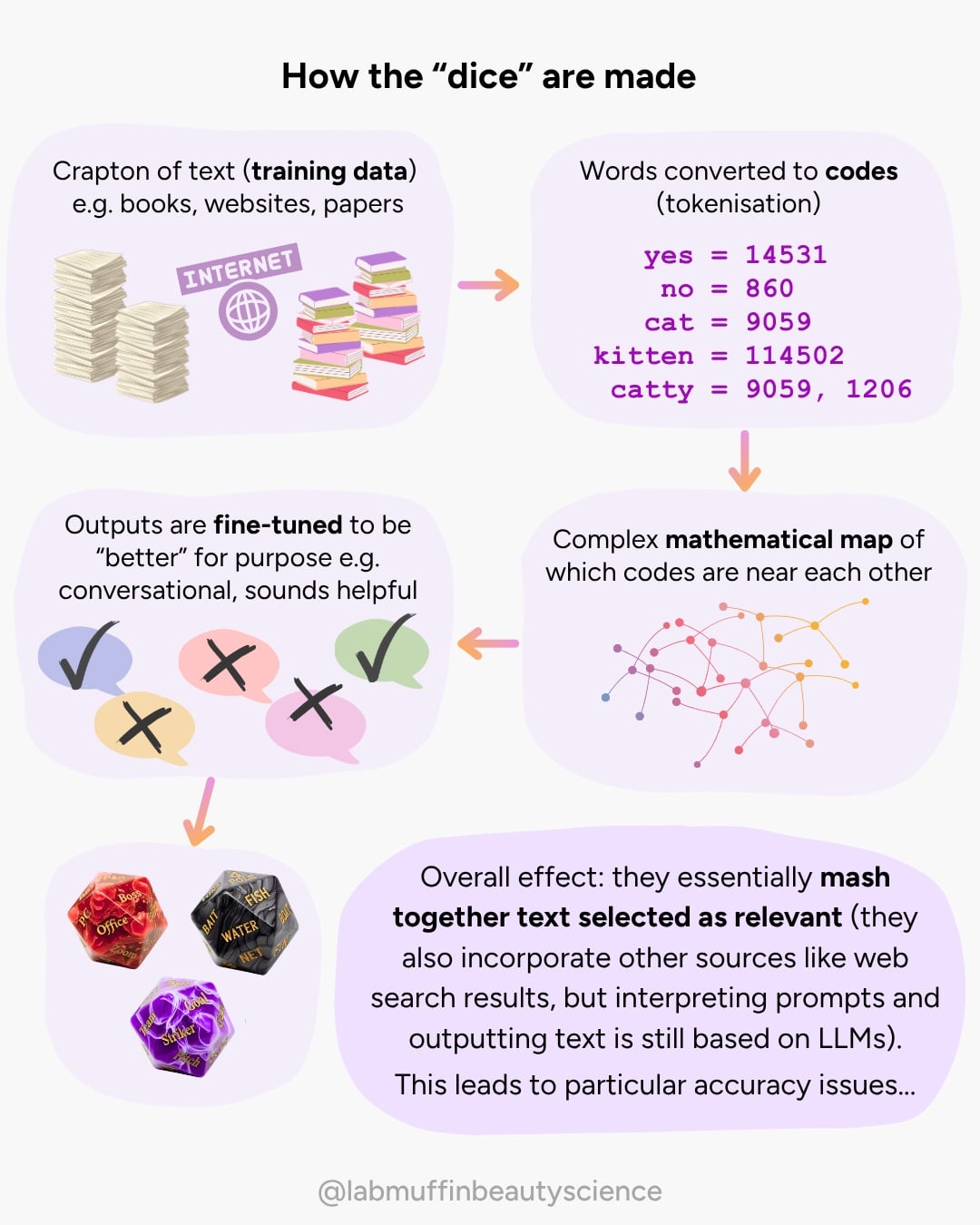
Think of it this way: an LLM has a vast, extraordinarily complex set of weighted probabilities for producing text. It selects words based on the prompt it receives and the words it has already generated. The training process involves converting huge amounts of text – books, websites, academic papers – into numerical codes, mapping the relationships between those codes, and then fine-tuning the outputs to sound fluent and helpful. Some systems incorporate live web searches, but the underlying architecture still uses LLM-based pattern-matching to interpret those results and compose a response.
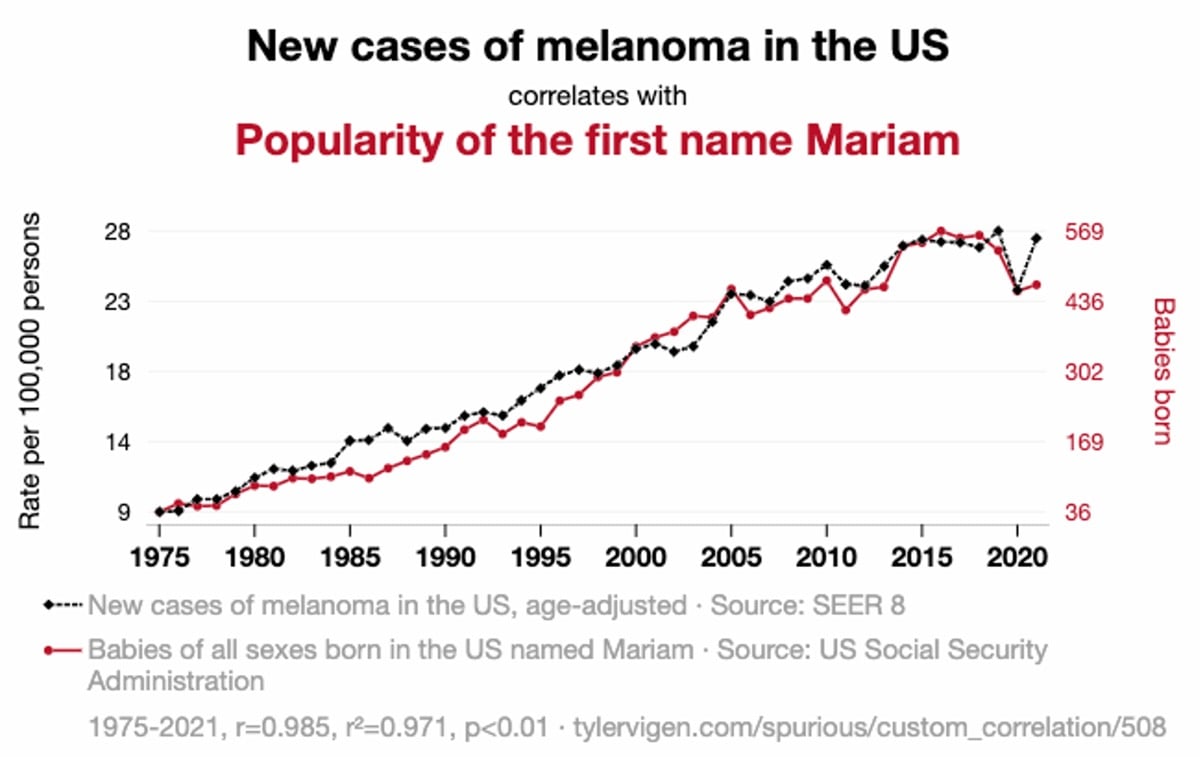
The output looks coherent because human language naturally correlates with meaning. But that correlation is not the same thing as the AI understanding or accurately reporting reality. Every response is, in a meaningful sense, a sophisticated reconstruction of patterns in text – not a verified statement of fact.
Why Science Content Is Particularly Vulnerable
For general, high-volume topics, AI chatbots can perform surprisingly well simply because there is so much text to draw from. Science – and skincare science especially – does not always have that luxury. Several factors make scientific content a particularly poor fit for LLM-based summarisation.
- Training data skews toward common myths. AI outputs reflect what is most prevalent online. In skincare, that means decades of marketing copy, oversimplified beauty journalism, and outright misinformation carry enormous weight in shaping what the model produces.
- Scientific language is precise in ways LLMs ignore. Rewording a peer-reviewed finding using general-purpose language patterns can subtly – or dramatically – alter what the sentence actually means. The model does not know this has happened.
- Paywalled research is largely inaccessible. Even tools marketed as capable of "deep research" predominantly pull from open-access sources, which disproportionately include marketing websites, journal abstracts without full context, and content from predatory publishers.
- Errors in legitimate research go undetected. Studies have found that roughly a quarter of citations in peer-reviewed papers do not actually support the claims they are attached to – and that is before accounting for the substantial body of preliminary, fraudulent, or methodologically weak research. An AI has no way to apply the subject-matter expertise needed to spot these problems.
- Prompt wording drives cherry-picking. Ask an AI a leading question about a skincare ingredient and it will tend to select sources that confirm your premise, not evaluate the full body of evidence.
These are not edge-case failures. They are structural features of how the technology works. A well-documented example: a study co-authored by a researcher with three non-Harvard colleagues was described by an AI as coming from "a Harvard team." The model generated something that sounded plausible and was technically connected to a word that appeared in the source material – but it was simply wrong.
The "Improvements" May Not Actually Help
The AI industry has introduced several techniques intended to increase accuracy. Chain-of-thought reasoning, where the model works through a problem step by step, appears more rigorous. Expert fine-tuning promises domain-specific reliability. Retrieval-augmented generation, which allows users to upload specific documents, seems to anchor the model to trustworthy sources. Each of these is genuinely interesting as a technical development – but there are real reasons to be cautious about how much they change the underlying problem.
Chain-of-thought models have been shown to alter their answers when certain words are added to a prompt, without acknowledging the change in their stated reasoning. The reasoning looks logical; it is not necessarily what drove the output. Fine-tuned clinical AI tools were recently found to perform no better than general-purpose chatbots on real medical queries – in some cases performing comparably to basic search engine AI overviews. And retrieval-augmented generation still relies on the original large training corpus to interpret prompts and generate fluent text; a model trained only on a small, curated dataset cannot produce coherent outputs at all.
The core issue remains: you need to already know the correct answer – or know whether a correct answer even exists – to reliably evaluate whether what an AI has generated is accurate. That requirement defeats a significant portion of the use case.
Fact-Checking AI Output Is Harder Than It Sounds
Even for a reader with some background knowledge, verifying AI-generated skincare science claims presents specific difficulties. AI text often contains a plausible-sounding mixture of accurate statements, subtly distorted statements, and outright fabrications – and these are woven together in prose that reads as confident and well-organized. Fabricated citations are a known and persistent problem: references that look legitimate but do not exist, or that exist but say something entirely different from what the AI claims.
For someone without specialist knowledge, these errors are nearly impossible to detect. For someone with specialist knowledge, the process of checking every claim against primary sources may take more time than simply doing the research properly from the start. In neither case is AI-generated science content a reliable shortcut.
What This Means for Skincare Information
The beauty and skincare space has a longstanding problem with misinformation – ingredient fearmongering, overstated clinical claims, misrepresented study findings. AI chatbots are not solving that problem. Because they weight their outputs toward whatever is most common in their training data, they are at least as likely to amplify existing myths as to correct them. And because their outputs arrive in authoritative, well-structured prose, readers may be less inclined to question them than they would be with an obviously promotional blog post.
None of this means AI tools have no legitimate uses in a research workflow. But treating a chatbot response as a trustworthy source of skincare science – without independent verification against primary literature, read carefully by someone with the relevant expertise – is a significant error. The confidence of the prose is not evidence of the accuracy of the content. Understanding that distinction is, at this point, an essential part of being a critical consumer of beauty information.