The Problem With AI-Written Science Content
There was a time when a post riddled with typos and grammatical mistakes was a reliable signal that something hadn't been checked carefully. That heuristic no longer holds. Today, the red flags have shifted – and if you consume any skincare science content online, understanding what AI-generated misinformation looks like has become genuinely important for your own protection.
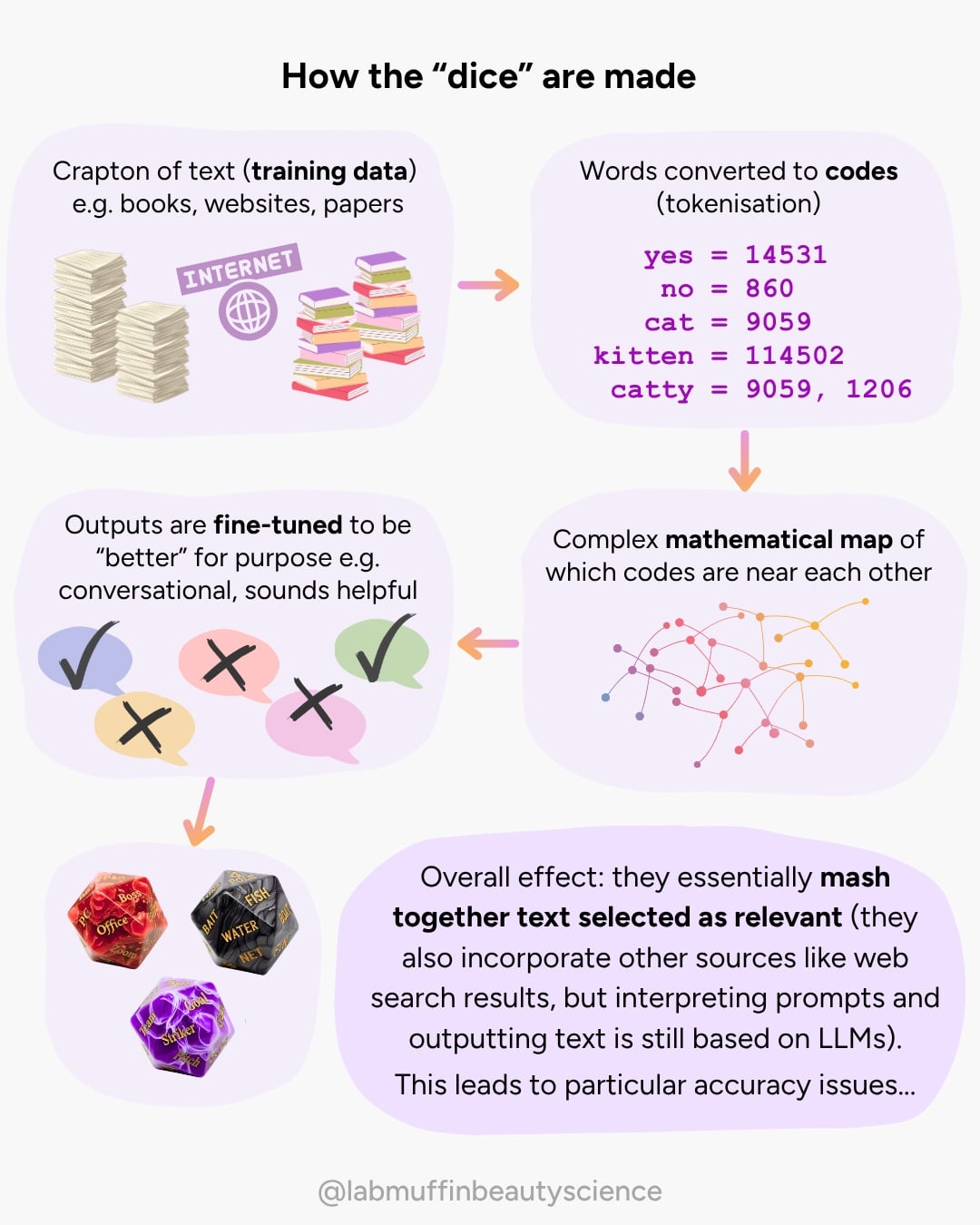
Large language model chatbots – ChatGPT, Claude, Gemini and their siblings – are known to have specific, recurring accuracy problems. Whether those problems are fixable in any meaningful sense remains an open question, but what is clear is that these tools are designed to feel authoritative. Confident, fluent prose is more profitable than cautious, hedged prose, and the companies behind these products have every incentive to build tools that feel trustworthy even when they are not. The result is text that reads smoothly and sounds credible while containing errors that would make a dermatologist wince.
This matters for an additional psychological reason: smooth, readable text feels more truthful to us. Cognitive scientists call this the fluency heuristic. When something is easy to process, our brains interpret that ease as a signal of accuracy. AI-generated content exploits this bias almost perfectly. It is far easier to have a chatbot mimic a writing style than it is to actually get the science right – which means that content showing multiple signs of AI generation is almost certainly unverified, and should be treated accordingly.
What Not to Do When Looking for AI Content
Before getting into the actual indicators, it helps to clear up what not to rely on. Formal grammar, polished punctuation and even a handful of stylistic quirks associated with AI writing are not, on their own, reliable proof of anything. Humans use em dashes. Humans write in bullet points. AI detection tools, meanwhile, have a poor track record – they flag human writing as artificial and miss genuine AI output with frustrating regularity.
The principle here is accumulation, not single-point identification. One suspicious feature means very little. A cluster of them, appearing together in a pattern that doesn't fit the author's usual output or the context of the post, is where the picture starts to become clear.
It is also worth noting that public callouts – naming and shaming suspected AI slop posters – tend to produce limited useful outcomes. People who are caught usually just get better at hiding their process. Incorrect accusations actively backfire, potentially encouraging more AI use among those who reason that if detection is unreliable, shortcuts are worth taking. There are also real equity concerns: the court of public opinion does not punish everyone equally, and research and lived experience both suggest that women of colour bear disproportionate scrutiny. The quieter, lower-stakes option of simply unfollowing is usually the more sensible choice.
Linguistic Patterns Worth Watching
That said, there are genuine linguistic patterns that appear with striking regularity in AI-generated text. These include:
- Heavy use of em dashes and semicolons
- Negative parallelism constructions: "It's not X, it's Y"
- Dramatic signposting: "Here's the twist:" or "And honestly"
- Minimalist declarations: "No X. No Y." or "[Topic] matters."
- The word "quietly" used for emphasis
- References to "the signal" as though it is a meaningful technical term
- Lists of exactly three items
- Bullet points and emojis used in ways that feel slightly off for the platform or the author
These patterns shift slightly as AI models are updated, but older posts showing these traits are still useful data points. If that content is still live and hasn't been corrected or acknowledged, it suggests the person either doesn't know about AI's accuracy limitations – or doesn't care. Neither scenario inspires confidence in their current output.
The Distinctive AI Science Voice
Beyond individual phrases, AI-generated science writing has a recognisable overall tone. It tends to treat everything as deeply significant. Basic, widely-known facts get reframed as revelations: "But here's what scientists discovered:" followed by something that has been on the label of a moisturiser for twenty years. Vague authority figures appear frequently – "scientists say" and "a German study found" – without citations, links or any mechanism for verification.
The writing is often wordy without being information-dense. The same idea appears two or three times in slightly different clothing. Simple words get replaced with elaborate synonyms, except when a phrase is being repeated for dramatic effect. Short, punchy sentences and rhetorical questions appear in clusters, manufacturing urgency. The overall effect is something between a LinkedIn thought-leadership post and a motivational poster – earnest, expansive, and curiously hollow when you try to extract the actual facts.
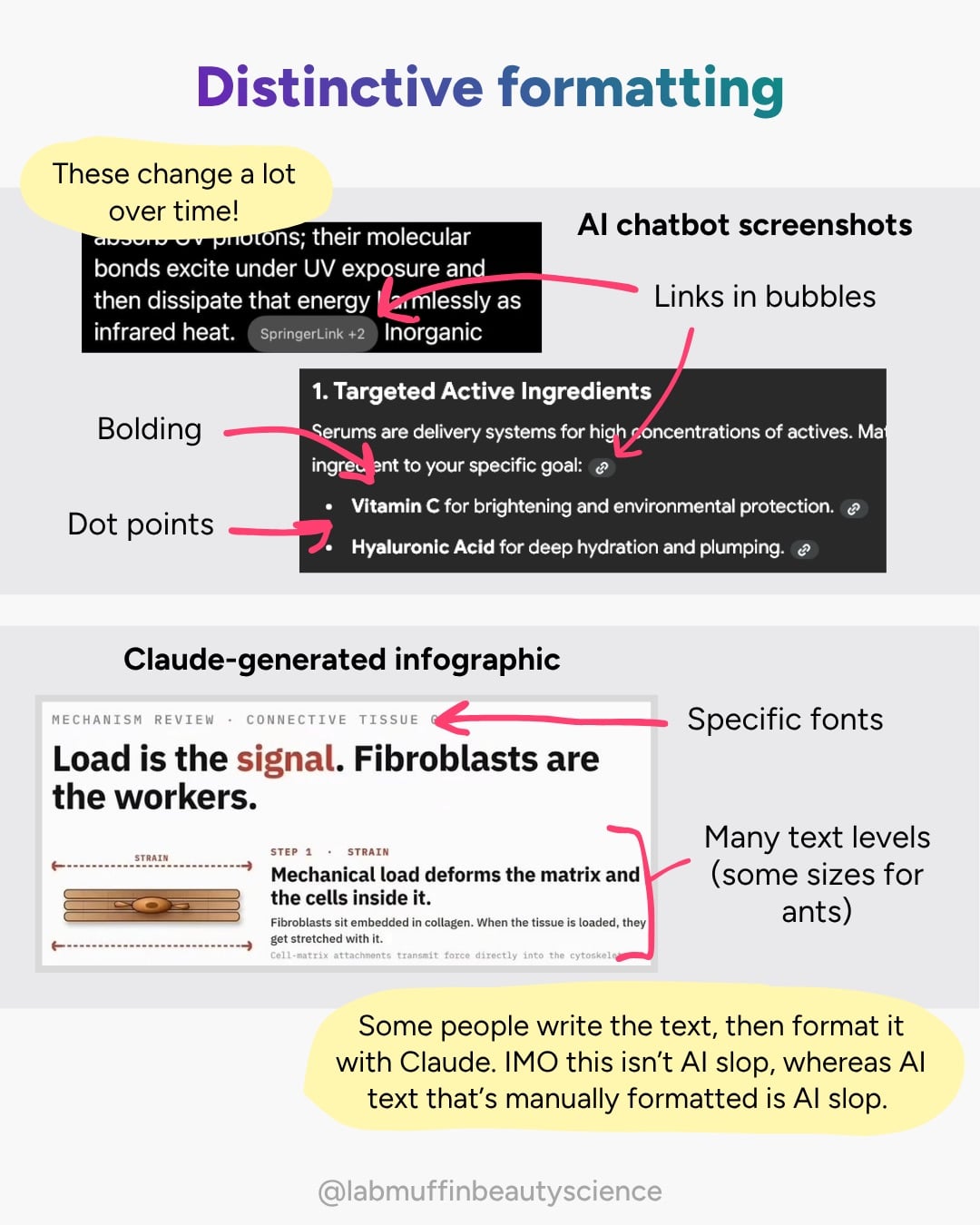
Screenshots of chatbot interfaces used directly as posts, or infographics built using AI tools like Claude, are also increasingly common in the skincare science space. Some creators write their own text and then use AI purely for visual formatting, which is a different matter. The concern is with AI-generated text being passed off as expert analysis.
Volume and Overconfidence as Warning Signs
One of the more telling indicators is sheer output volume. Producing accurate, well-researched science content takes time. Reading a single scientific paper carefully and understanding it well enough to communicate it accurately can take several hours. Scientific expertise is also narrow by nature – genuine specialists know a lot about a small area, and need time to get up to speed on adjacent topics.
AI-assisted posters, by contrast, tend to publish frequently, at length, across a wide range of topics, with consistent and unearned confidence. This pattern has parallels in academic fraud; one notorious rosemary oil study, widely circulated in hair-growth discussions, came from an author who had published over 369 papers in a single year – a volume that is not humanly possible while maintaining any meaningful quality control.
When you see a skincare account posting long, science-adjacent content daily across wildly different topics – one day retinol mechanisms, the next collagen supplements, the next SPF chemistry – with no apparent gaps in confidence or knowledge, that pattern alone warrants extra scrutiny on the underlying claims.
Checking Your Own Assumptions
Perhaps the most important takeaway is that most of us overestimate our ability to detect AI-generated content by reading it. The fluency heuristic works on everyone, including people who are aware of it. The practical response is not to try to become a perfect AI detector, but to apply the same critical standards to smooth, confident online science content that you would apply to anything else: look for citations, check whether named studies actually exist and say what they're claimed to say, and be particularly cautious about dramatic claims dressed up in the language of discovery.
AI tools are not going away, and some uses of them are entirely reasonable. But in the specific context of skincare science – where ingredient interactions, dosages and formulation chemistry have real consequences for real skin – the cost of acting on inaccurate information is not trivial. The ability to read content critically, rather than fluently, is increasingly the skill that matters.