A misleading chart is making the rounds
A graph showing rising skin cancer rates alongside a general timeline of growing sunscreen use has been circulating on social media, with commentators arguing that sunscreen is either ineffective or actively harmful. At first glance, the pairing looks suspicious. Look closer, though, and the argument falls apart almost immediately.
The claim – repeated across TikTok and wellness circles – goes something like this: sunscreen use has increased since the 1970s, skin cancer rates have also increased, therefore sunscreen is not working or is making things worse. It sounds logical. It is not.
Correlation, causation, and a basic statistical error
The most fundamental problem is that this is not even a proper correlation. The graphs being shared show melanoma incidence trending upward since the 1930s, decades before sunscreen was widely used. There is no side-by-side data line tracking sunscreen usage – only an assumption that two upward trends on separate charts must be connected.
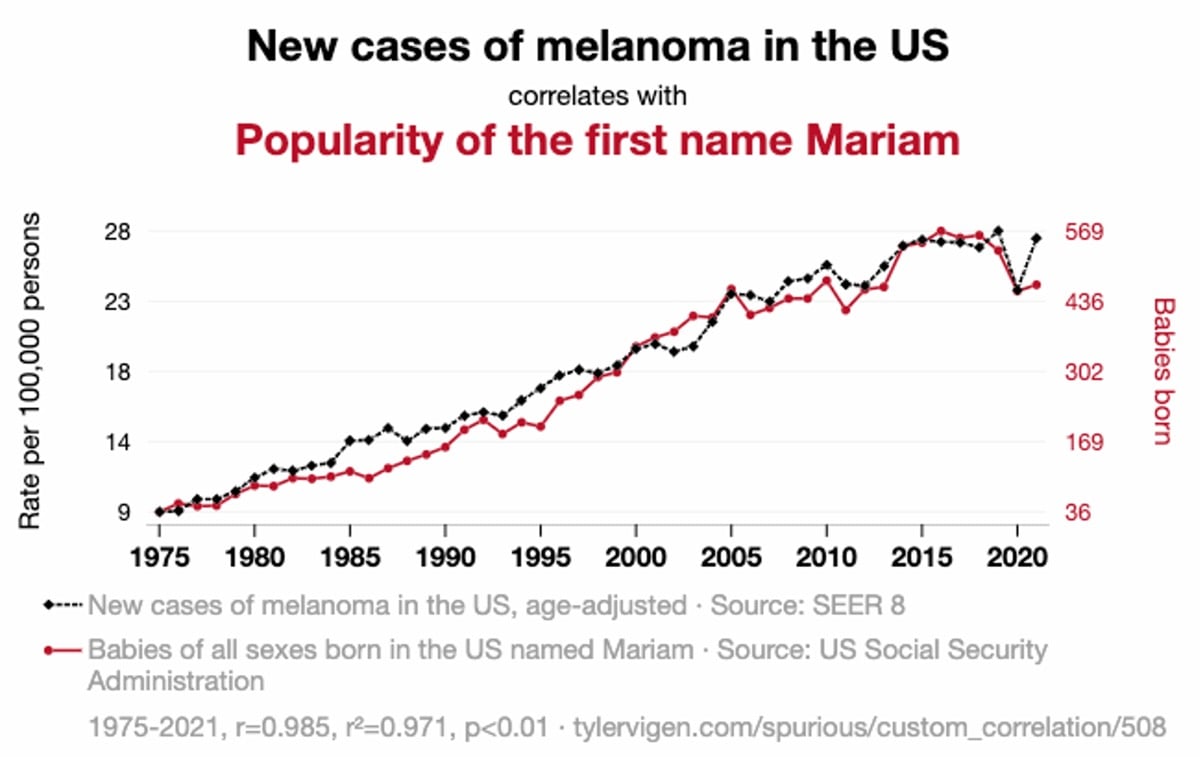
By the same reasoning, you could argue that skin cancer is caused by increased chocolate consumption, rising electricity usage, or growing car sales. All of those have trended upward over the same period. There are entire databases dedicated to cataloguing these kinds of absurd statistical coincidences – including one that shows US melanoma rates tracking suspiciously well against the popularity of certain baby names. The point is that two things rising at the same time tells us nothing about whether one is causing the other.
Sunscreen did not become a product in widespread everyday use until the 1970s. The increase in melanoma diagnoses visible on historical charts is a trend that predates mass sunscreen adoption by several decades. The line was already going up.
What controlled research actually shows
To move beyond the noise of real-world trends – where countless variables interact at once – scientists conduct randomised controlled trials, or RCTs. These studies isolate a single variable and track outcomes across two comparable groups. For sunscreen, the most significant RCT ever conducted was the Nambour Trial, carried out in Queensland, Australia.
Participants were matched by location, age, and skin tone, then divided into two groups. One group applied sunscreen every day without exception. The other applied it only when they personally felt like it – the so-called discretionary group. The active trial period ran for four and a half years, with researchers continuing to monitor participants for a further decade after that.
If sunscreen caused or accelerated skin cancer, the daily sunscreen group would have shown worse outcomes. The opposite was true:
- Squamous cell carcinomas were reduced by 40% during the trial period
- New squamous cell carcinoma incidence was roughly one-third lower eight years after the trial ended
- Actinic keratoses – precancerous lesions – dropped by 24% within the first two years
- Invasive melanoma was reduced by 73% over the full fifteen-year follow-up period
- Where melanomas did develop in daily users, they were significantly thinner on average – 0.53 mm compared to 1.2 mm in the discretionary group, an important indicator of severity
As a secondary finding, daily sunscreen users also showed 24% fewer visible signs of skin ageing. The trial is considered one of the most rigorous pieces of evidence in dermatological research.
Laboratory work reinforces these findings. Studies applying varying amounts of sunscreen to skin before exposing it to UV radiation equivalent to sunlight have measured the formation of pyrimidine dimers – DNA mutations that represent the earliest step in the pathway toward skin cancer. The results are straightforward: more sunscreen, fewer DNA mutations.
So why are rates still climbing?
If sunscreen works, why are diagnoses still rising in most countries? The answer is that several powerful forces are pushing rates upward, and they outweigh the downward pressure that sunscreen alone can exert at a population level.
People are living longer
The average age at melanoma diagnosis is around 65. As life expectancy has increased, more people are surviving long enough to develop cancers that would previously have gone undetected because patients had already died of other causes. More years alive means more time for cells to accumulate UV-driven mutations.
Sun exposure patterns have changed
Cheaper air travel has made beach holidays accessible to far more people than in previous generations. Many of those travellers spend the majority of their working lives indoors, meaning their skin receives relatively little regular sun – then they subject it to intense UV radiation for an intense burst of a week or two each year. This pattern of intermittent, high-intensity exposure is considered particularly associated with melanoma risk.
Tanning culture
The social desirability of tanned skin remains significant in many countries. Notably, US regulatory oversight of sunscreen products developed around the same period that UV tanning beds became commercially widespread – introducing an entirely new and concentrated source of UV exposure into daily life.
Better detection
Greater public awareness of warning signs – including the widely promoted ABCDE criteria for evaluating suspicious spots – means both patients and clinicians are identifying lesions that might previously have gone unnoticed or been dismissed. More diagnoses does not necessarily mean more disease; it can simply mean better surveillance.
The exception that proves the point: Australia's younger population
Perhaps the most telling data point in this entire debate is what has happened in Australia. While melanoma rates continue to rise in most parts of the world, rates among Australians under 40 have actually fallen. In the 15-to-24 age group, melanoma incidence has roughly halved since the 1980s.
Researchers attribute this to a combination of increasing population diversity and, critically, the country's sustained SunSmart public health campaigns. Australia has maintained one of the most coordinated, multi-decade approaches to sun protection of any nation, and the results in younger cohorts reflect that investment.
Sunscreen is part of the picture, not all of it
What makes Australia's SunSmart model notable is that it was never purely about telling people to buy and apply more sunscreen. Simply knowing that a behaviour reduces cancer risk is rarely sufficient to change what people actually do – behaviour is shaped by social norms, convenience, and deeply held values. Effective public health approaches address those factors directly, through shade infrastructure, protective clothing, adjusted outdoor schedules, and sustained cultural messaging.
The lesson from the data is not that sunscreen is ineffective – the Nambour Trial alone dismantles that claim. The lesson is that sunscreen is one tool within a broader strategy, and that no single intervention will offset the combined weight of an ageing population, changing travel habits, and decades of tanning culture. Rising skin cancer rates are a genuine public health concern. Blaming sunscreen for them, however, is a misreading of the evidence that risks discouraging one of the few sun-protection behaviours with strong, long-term clinical support behind it.