Why Sunscreen Doesn't Last All Day
Most sunscreen packaging instructs users to reapply every two hours, yet few people who wear makeup actually follow through. The friction of daily life – hair brushing against cheeks, hands touching faces, collars rubbing necks – physically removes sunscreen from skin over the course of a day. Less product on the skin means less protection, full stop.
But physical removal is only part of the story. When sunscreen is first applied in sufficient quantity, it settles into a continuous, even film across the skin's surface. That film is its own enemy. As the hours pass, the natural oils and moisture the skin produces begin to disrupt it. The film breaks apart, migrates into pores and fine lines, and clumps unevenly. Anyone who has watched foundation under a microscope will recognize the pattern – a product that looks smooth and uniform at application begins to fragment visibly within a few hours. Sunscreen behaves the same way, even if the effect is invisible to the naked eye.
There is also the matter of the film thinning out. Sunscreen evaporates and absorbs into the upper layers of the skin over time, and as the film becomes thinner, its ability to absorb or reflect UV radiation changes for the worse. Finally, certain older organic – sometimes called chemical – filters are not photostable, meaning UV exposure itself breaks them down. Modern sunscreen formulations have largely addressed this by using inherently photostable filters or by combining less stable ingredients with stabilizing agents. That said, photostability does not solve the first two problems, so even the most advanced contemporary sunscreens will still degrade in coverage throughout the day.
What the Research Actually Shows
Concrete data on how quickly sunscreen degrades under normal daily conditions is surprisingly thin. One study stands out as particularly relevant. Twenty participants applied sunscreen at the standard tested quantity of 2 mg per cm² – the amount used in laboratory SPF measurements – with a tracking dye added so researchers could photograph and measure coverage at regular intervals. Participants were permitted to go outside for up to an hour during the study period, but no additional products were applied to their faces.
The findings were telling. At the two-hour mark, an average of 16 percent of the dye – and by extension the sunscreen – had disappeared from the skin. By the four-hour point, another 7 percent had gone. At eight hours, a further 4.5 percent had been lost, bringing the total reduction to nearly 30 percent. That means after a full day of relatively low-activity wear, roughly a third of the original sunscreen coverage was gone.
To put that in practical terms: SPF 50 becomes approximately SPF 35 after that kind of wear. SPF 30 drops to around SPF 21. SPF 15 falls to roughly SPF 10. The relationship between SPF value and the quantity of sunscreen on the skin is approximately linear, which means starting with a higher SPF provides a meaningful buffer. Someone wearing SPF 50 at the start of the day still has meaningful protection by the end of it; someone who started with SPF 15 may be significantly underprotected.
It is worth noting that these results cannot be applied universally. Water-resistant formulations are designed to maintain adhesion under physical disruption and tend to last longer. Some chemical filters absorb into the stratum corneum, which can help anchor them in place. The study provides a useful general picture, not a definitive rule for every product.
Deciding Whether to Reapply – and How Much
Whether residual protection is sufficient depends entirely on two factors: how much UV exposure you are actually receiving, and how concerned you are about the long-term effects of that exposure – primarily skin cancer risk, photoaging, and hyperpigmentation. There is no single correct answer. Reapplying sunscreen over makeup will, to some degree, disturb that makeup. There is no method that sidesteps this compromise entirely. The question is how much compromise is acceptable given your specific circumstances.
A practical framework based on sun exposure levels can help structure the decision:
Low Sun Exposure Days
On days when the majority of time is spent indoors, with only brief and largely indirect sun exposure during a morning or evening commute, skipping reapplication is a reasonable choice for many people. The residual sunscreen on the skin, combined with deliberate habits like walking on the shaded side of the street or positioning yourself away from windows during the bulk of the day, can provide adequate coverage. This is not negligence – it is a proportionate response to a genuinely low UV burden.
High Sun Exposure Days
Spending extended time outdoors – at a beach, a sporting event, a festival, or simply walking through a sunny city for several hours – changes the calculation entirely. In these situations, reapplication is strongly advisable, and doing so properly matters more than preserving the look of makeup. Applying a lotion sunscreen with clean hands and patting it gently over the face, accepting that some makeup will shift or smear, is the most effective option. Coverage and SPF accuracy take priority.
Moderate Sun Exposure Days
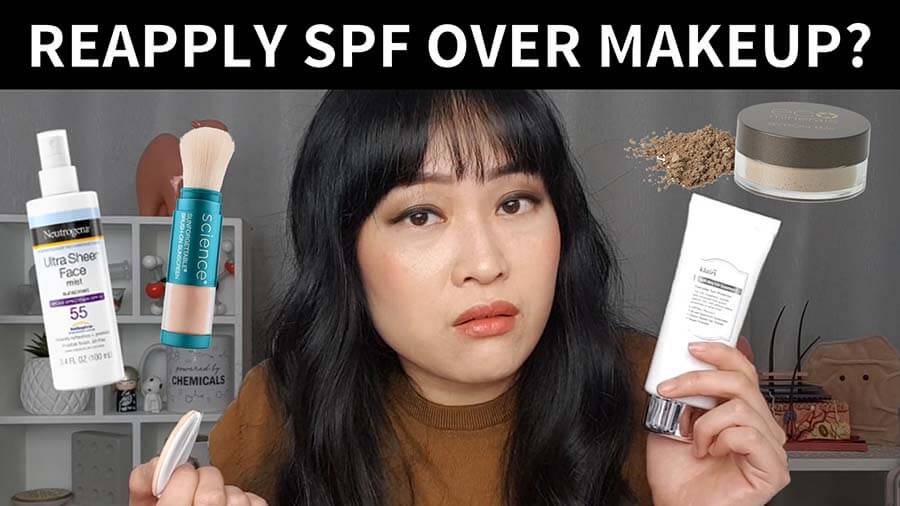
This is the most common scenario – a lunch break outside, a few errands, some time near windows. Here, a lighter reapplication method becomes both relevant and practical. Several product formats are worth considering:
- SPF powders: These are among the most makeup-friendly options. They can be dusted over foundation without significantly disrupting it and add a degree of UV protection. The limitation is that achieving the quantity needed to match labeled SPF is nearly impossible with a powder brush application alone, so they work best as a complement to an existing sunscreen base rather than a standalone reapplication.
- SPF sprays: Facial mists and sprays with sun protection factors offer a quick, non-disruptive way to add some coverage. They suffer from the same quantity problem as powders – it is difficult to ensure even, adequate coverage through a spray alone – but they can boost protection meaningfully when used generously and patted in rather than simply misted and left.
- Tinted or SPF foundations: Touching up makeup with a product that contains a sun protection factor allows for reapplication and cosmetic correction at the same time. The caveat, again, is quantity – the amount of foundation most people apply for touch-ups is far less than what would be needed to achieve the labeled SPF on its own.
- Lotion sunscreen applied over makeup: The most protection-accurate method, and the most disruptive to a finished look. Using a lightweight, fast-absorbing formula and patting – rather than rubbing – it onto the skin minimizes but does not eliminate makeup disturbance. For high-exposure days, this remains the gold standard.
The Bigger Picture
The reapplication question is ultimately about calibrating protection to real-world conditions rather than treating a two-hour rule as an absolute across every circumstance. Starting with a higher SPF – preferably SPF 50 or above – creates a buffer that makes the inevitable degradation over the course of a day less consequential. Choosing a water-resistant formula adds further staying power. And building simple sun-avoidance habits into daily routines – shade, windows, timing – reduces the UV load that any sunscreen has to manage in the first place.
No product, however advanced, maintains perfect SPF performance from morning to night without reapplication. But with a clear understanding of how and why protection declines, it becomes far easier to make informed, proportionate decisions about when and how to top it up – without treating every day as a worst-case scenario.