For anyone whose skin treats the average beauty product like a personal insult, finding a sunscreen that genuinely agrees with your complexion can feel like an exhausting pursuit. Fragrance, preservatives, and certain UV-filtering chemicals can all set off a cascade of redness, stinging, or allergic response in sensitive skin types. But the good news is that the market has shifted meaningfully in recent years, with brands developing mineral-based formulas that are as elegant to wear as they are kind to reactive skin.
The distinction between mineral and chemical sunscreens matters enormously here. Chemical filters such as oxybenzone and avobenzone work by absorbing UV radiation and converting it to heat within the skin – a process that can irritate already-sensitized complexions. Mineral sunscreens, by contrast, use zinc oxide and titanium dioxide as their active ingredients, sitting on top of the skin and physically deflecting UV rays rather than penetrating the surface. That surface-level action is precisely why dermatologists frequently steer sensitive-skin patients toward mineral formulations.
Every product highlighted below follows that mineral-only principle. What sets them apart from one another is how they layer additional skin-care benefits – hydration, barrier repair, color correction – on top of that foundational UV protection.
Best Overall: EltaMD UV Skin Recovery Red Color Correcting Green Tint SPF 50
At $53, this EltaMD formula is the kind of product that earns its place as a daily non-negotiable. A 2025 Best of Beauty Award winner, the UV Skin Recovery SPF 50 does considerably more than block UV rays. Its green tint comes from Centella asiatica – better known as cica – an ingredient with a well-established reputation for calming inflammation and visually counteracting redness through basic color theory. The green pigment neutralizes the red tones in the skin on contact, then sheers out as it's blended, leaving no visible tint behind.
The formula's amino acid complex – composed of taurine, arginine, and glycine – was developed through more than 100 rounds of testing and is designed to help repair existing skin damage while building resilience against future irritation. Ceramides are also present in meaningful amounts, working to reinforce the skin barrier and lock in hydration across the day.
Testers with combination skin reported that the texture reads more like a moisturizer than a sunscreen, with a dewy finish that felt unusual – in the best possible way – for an all-mineral formula. It layered cleanly under multiple foundation formulas without pilling, and produced no white cast whatsoever.
- Type: Mineral
- Key ingredients: 12.9% zinc oxide, amino acid complex, cica, ceramides
- Tinted: Yes (green tint)
- Water-resistant: No
- Fragrance-free: Yes
Best for Redness: Innisfree Daily UV Mineral Sunscreen SPF 45
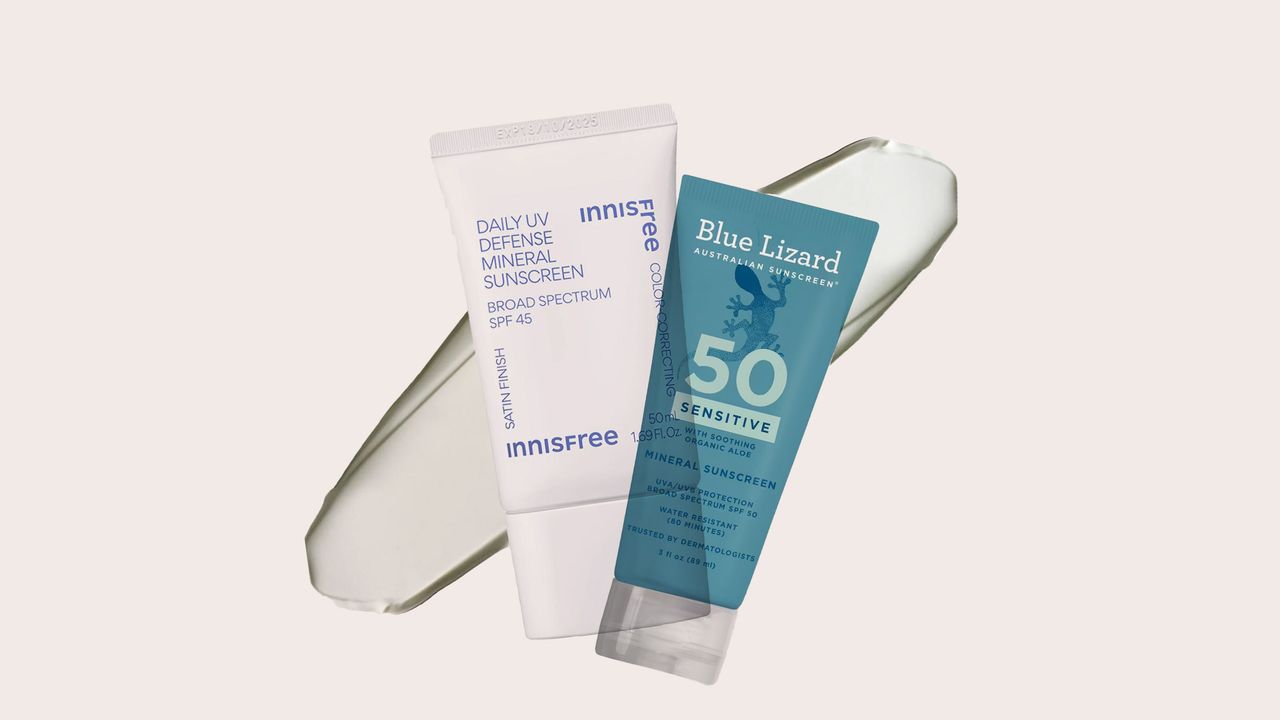
At $22, the Innisfree Daily UV Mineral Sunscreen SPF 45 is an accessible entry point for anyone chasing redness correction alongside solid sun protection. Also a 2025 Best of Beauty Award winner, this formula contains 17% zinc oxide for broad-spectrum mineral coverage – a concentration that New York City-based dual board-certified dermatologist Dr. Jane Yoo notes is effective at neutralizing visible redness while offering reliable UV defense.
Where this sunscreen really distinguishes itself is in its hydration stack. Eight distinct forms of hyaluronic acid work alongside squalane to maintain skin moisture throughout the day, while cica addresses sensitivity and redness from a soothing angle. The texture is slightly denser than the featherweight formulas Korean skincare is often celebrated for, but a little extra time working it into the skin resolves that easily enough.
The practical upside of its redness-neutralizing tint is real: wearing it can meaningfully reduce how much concealer or foundation you need to reach for afterward, making it a strong candidate for a streamlined morning routine.
- Type: Mineral
- Key ingredients: 17% zinc oxide, eight types of hyaluronic acid, squalane, cica
- Tinted: Yes (subtle green tint)
- Fragrance-free: Yes
Best Drugstore Pick: La Roche-Posay Anthelios 50 Mineral Ultra Light Sunscreen
La Roche-Posay has long been a dermatologist-recommended name in sensitive-skin care, and the Anthelios 50 Mineral Ultra Light Sunscreen at $43 demonstrates why that reputation holds. Despite its mineral formulation, the texture is genuinely lightweight – a quality that has historically been difficult to achieve with zinc oxide and titanium dioxide alone. For those who have avoided mineral sunscreens specifically because of their tendency to feel heavy or leave a chalky residue, this formula is worth revisiting the category for.
Best for Reapplication Over Makeup: Colorescience Sunforgettable Total Protection Brush-On Shield SPF 50
Reapplying sunscreen midday is one of those skincare steps that most people skip simply because it feels incompatible with wearing makeup. The Colorescience Sunforgettable Total Protection Brush-On Shield SPF 50, priced at $58, solves that problem with a loose-powder mineral formula dispensed through a built-in brush. It applies directly over foundation and setting powder without disturbing the makeup underneath, making it a genuinely practical tool for maintaining protection throughout the day.
What to Know When Shopping for Sensitive-Skin Sunscreens
When evaluating any sunscreen for reactive skin, there are a handful of formulation factors worth scrutinizing before purchase. Fragrance – whether synthetic or natural – is one of the most common contact allergens in skincare and appears in more sunscreens than you might expect. Alcohol, particularly denatured alcohol, can be drying and irritating in higher concentrations. Chemical UV filters including oxybenzone, octinoxate, and homosalate are worth avoiding if your skin has shown sensitivity to sunscreens in the past.
Beyond what a formula excludes, the presence of certain ingredients actively supports sensitive skin during sun protection. Centella asiatica, niacinamide, ceramides, and hyaluronic acid all appear across the products listed here for good reason – they address hydration, barrier integrity, and inflammation simultaneously, turning daily SPF application into a multi-purpose skin-health step rather than a reluctant obligation.
Finally, no sunscreen performs well without consistent reapplication. Regardless of SPF rating, mineral or otherwise, broad-spectrum protection should be reapplied every two hours when outdoors – or immediately after swimming or heavy sweating. A product like the Colorescience brush-on makes that step easier to stick to, which ultimately matters more than any single formulation detail.