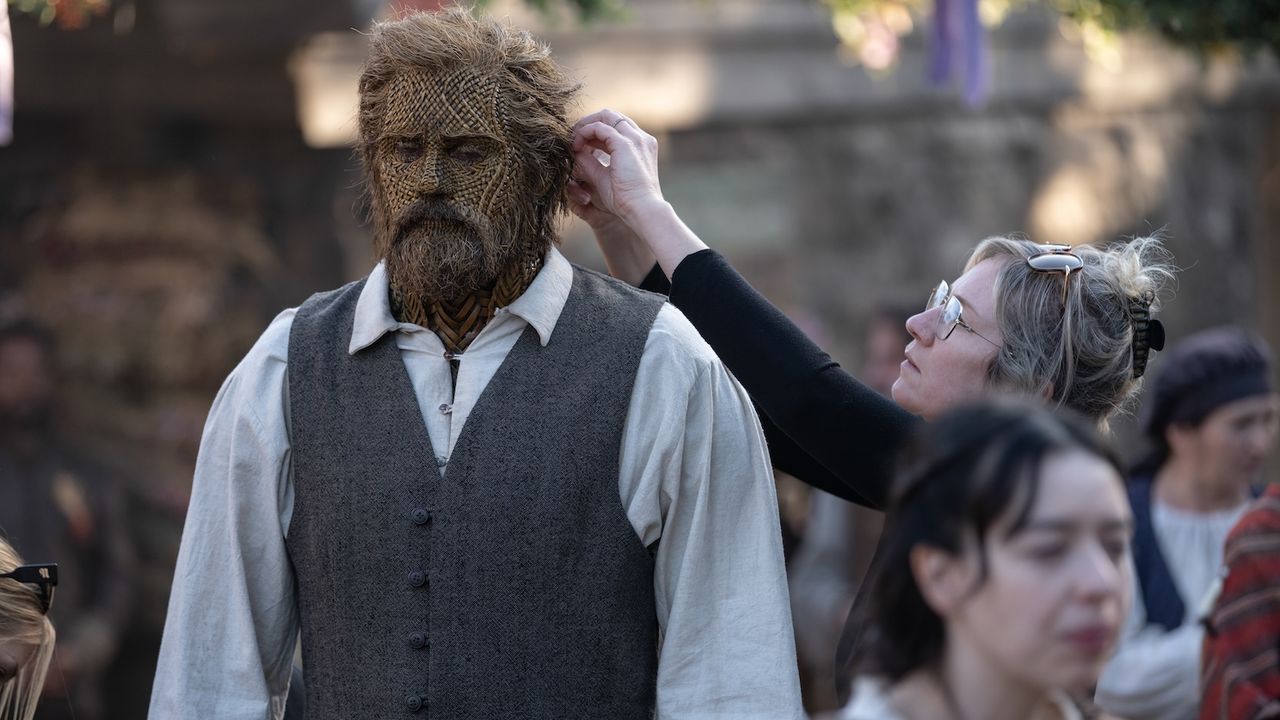
There is a moment in the trailer for Wicker – the new romantic comedy from directors Alex Houston Fischer and Eleanor Wilson – where Alexander Skarsgård, covered head to toe in interlocking woven reeds, turns his gaze toward Olivia Colman and the internet promptly loses its mind. Within days of the July 30 release of that two-and-a-half-minute clip, T-shirts bearing the phrases "Worth the Splinters" and "Wicker Dicker" appeared on Etsy. TikTok users began scheming about stealing life-size cardboard theater displays of the rattan figure. One Threads post captured the mood perfectly: "I am 100% going to see the Wicker film because I never thought anyone would ever write a screenplay exploring the deeply impure feelings they experienced while walking into a Pier One Imports."
The film's premise is deliberately absurd and entirely earnest. In a medieval English coastal village, a lonely fisherwoman (Colman) refuses the institution of marriage and instead hires the local basketmaker (Peter Dinklage) to weave her a husband from wicker (Skarsgård). The townspeople who once tormented her are scandalized when they discover that this husband – woven from willow rods and river reeds – loves her with a devotion no human man ever managed. The basketweaving craft vocabulary does the film no harm either: terms like "tucking," "waling," and "rim" carry an accidental charge, and the description of willow rods as having "a thick butt end and a thin tip" reads like something smuggled in from a different genre entirely.
But here is the thing about a film that depends on audiences finding a sentient basket attractive: the desire has to be earned. It cannot be ironic. The Wicker Husband needs to register as genuinely desirable, and that requires something far more technically demanding than casting a tall Swede with good cheekbones – though that certainly did not hurt.
Bringing Science to the Art of Prosthetic Makeup
To pull off the visual feat, the production turned to New Zealand-based design and visual effects studio Wētā Workshop. Prosthetic makeup designer Joe Dunckley and lead makeup-effects artist Sarah Rubano led the team, and they were given something relatively rare in film production: time. Eighteen months of research and development preceded principal photography, allowing Dunckley and his colleagues to approach the problem with methodical precision rather than last-minute improvisation.
The process began with 2D concept art – mapping the shapes the team needed to construct across Skarsgård's face and body – before moving into collaboration with Auckland-based weaver and textile artist Jasmin Van Lith. Van Lith, who also contributed to handcrafted physical garments for the Avatar franchise, created physical samples of realistic weave patterns calibrated for different regions of the body and face. Her job was not merely aesthetic; it was biomechanical.
"If you're smiling, the corners of your mouth need to lift 20 millimeters, and we need to allow for that much movement in the weave pattern," Dunckley explains. "We could take that information and she would give us a physical weaving sample that would conform to that amount of movement in that direction."
To determine exactly how much movement was required in each area, the team used 3D animation software to model Skarsgård's facial expressions precisely. This gave Van Lith the specific parameters she needed and gave the Wētā sculptors exact data when they re-created her samples digitally on a scan of Skarsgård's face and body.
3D-Printed Prosthetics: A Possible First
What resulted from that digital sculpting phase was a set of wearable pieces – referred to in the industry as "appliances" – that Dunckley believes may represent a genuine innovation in the field.
"There have been sculpted prosthetics in 3D before, and you can mold prosthetics in 3D, but we're directly printing the prosthetic appliances that we applied on Wicker," he says. "It was an extraordinary development phase and something we're really proud of because we think they could be the very first 3D-printed prosthetic appliances."
The finished system comprised ten facial appliances and fifty interlocking body pieces, the latter stitched onto power mesh or spandex to create a wearable underlayer. The facial pieces covered nearly every surface: ears, lips, under lips, eye bags, and a substantial piece Rubano nicknamed the "Batman mask," which spanned the forehead, nose, and cheekbones. A jaw piece completed the facial coverage. By the time production was in full swing, Dunckley and Rubano had refined the application process to approximately ninety minutes per session.
The Wig, the Lashes, and the Details That Made It Work
Skarsgård's hair presented its own set of considerations. The wig was constructed from muka – a fiber derived from New Zealand flax and a material central to Māori traditional textiles – with individual strands knotted onto a lace base using the same technique employed for human hair wigs.
"Those strands were knotted onto the weave just like you would a human hair wig, knotting onto the lace," Rubano explains. The choice of muka was practical as well as thematic: its natural texture and color reads as organic material under camera, grounding the character visually in the world of woven plant fibers rather than theatrical costume.
According to Rubano, Wicker Husband's eyes were the single most difficult feature to resolve. The eyes are the primary site of human emotional connection – where audiences decide whether they believe and, crucially, whether they care. Getting the eye area right was not optional; it was the entire game.
Hotness as a Design Brief
Throughout the development process, the team operated under an explicit creative directive: Wicker Husband had to be attractive. Not interesting. Not unusual. Hot.
"He needed to be the object of desire," says Dunckley. "He needed to be the hot basket. But Alexander himself was the key inspiration for the design."
That meant the prosthetics could never obscure Skarsgård so completely that his expressiveness disappeared beneath them. The entire technical architecture of the makeup – the 3D movement modeling, the custom weave patterns, the carefully engineered appliance placement – existed in service of a single outcome: keeping the actor readable, present, and magnetic on screen.
It is, in a strange way, a story about what good special-effects makeup has always tried to do. The material transforms the surface; the person underneath still has to do the work. In Wicker, that balance between the constructed and the human is not just a technical challenge. It is the entire point of the film.
- Total prosthetic pieces: 60-plus, including 10 facial appliances and 50 body pieces
- Application time on set: Approximately 90 minutes
- Development period: 18 months before principal photography
- Hair fiber: Muka, derived from New Zealand flax
- Studio: Wētā Workshop, New Zealand
- Textile collaborator: Jasmin Van Lith, weaver and textile artist